
 Chat with us on WhatsApp

Swivel Vs Fixed Bar Stools
Choosing between swivel and fixed bar stools changes how a kitchen island or breakfast bar works in daily use. The difference is not just movement. It affects walkway clearance, stability, comfort during longer sitting periods, and how easily people can get in and out of the seat.
Swivel stools allow the seat to rotate, usually through a 360-degree mechanism. Fixed stools stay locked in position. Both options work well in the right setting, but they suit different layouts and usage patterns.
If you are still deciding on overall sizing and fit, it helps to read Lakeland’s bar stool size guide first. Seat height accuracy matters more than swivel functionality, especially for kitchen islands and breakfast bars with limited clearance.
What Is A Swivel Bar Stool?
A swivel bar stool is a stool with a rotating seat, usually capable of turning 360 degrees. The seat rotates independently from the base, allowing people to turn without dragging the stool across the floor.
This movement is useful in social spaces where people regularly turn to talk, move between kitchen and dining areas, or get on and off the stool from different angles. Some swivel stools also include a memory return mechanism, which automatically returns the seat to a forward-facing position after use.
Many swivel models also combine rotation with gas-lift height adjustment. If you are comparing fixed heights against adjustable mechanisms, the counter height vs bar height guide explains the main sizing differences.
What Is A Fixed Bar Stool?
A fixed bar stool has a stationary seat with no rotational movement. The base and seat remain locked together, creating a more predictable footprint around the island or counter.
Fixed stools are mechanically simpler. There are fewer moving parts, less internal hardware, and usually less side-to-side movement over time. They are commonly chosen for narrow kitchen layouts, family kitchens, and spaces where consistent positioning matters more than movement.
Fixed stools can still be upholstered, padded, adjustable in height, or supplied with backs and arms. The difference is simply that the seat does not rotate.
Swivel Vs Fixed Bar Stools: The Main Differences
| Feature | Swivel Bar Stools | Fixed Bar Stools |
|---|---|---|
| Seat Movement | 360-degree rotation | No rotation |
| Ease Of Getting On/Off | Usually easier | Requires moving the stool slightly |
| Space Requirements | Needs more clearance | Smaller working footprint |
| Mechanical Complexity | More moving parts | Simpler construction |
| Family Safety | Can encourage spinning | More predictable movement |
| Social Interaction | Better for open-plan spaces | More fixed seating position |
| Long-Term Stability | Depends on mechanism quality | Typically more rigid |
Which Option Works Better In Small Kitchens?
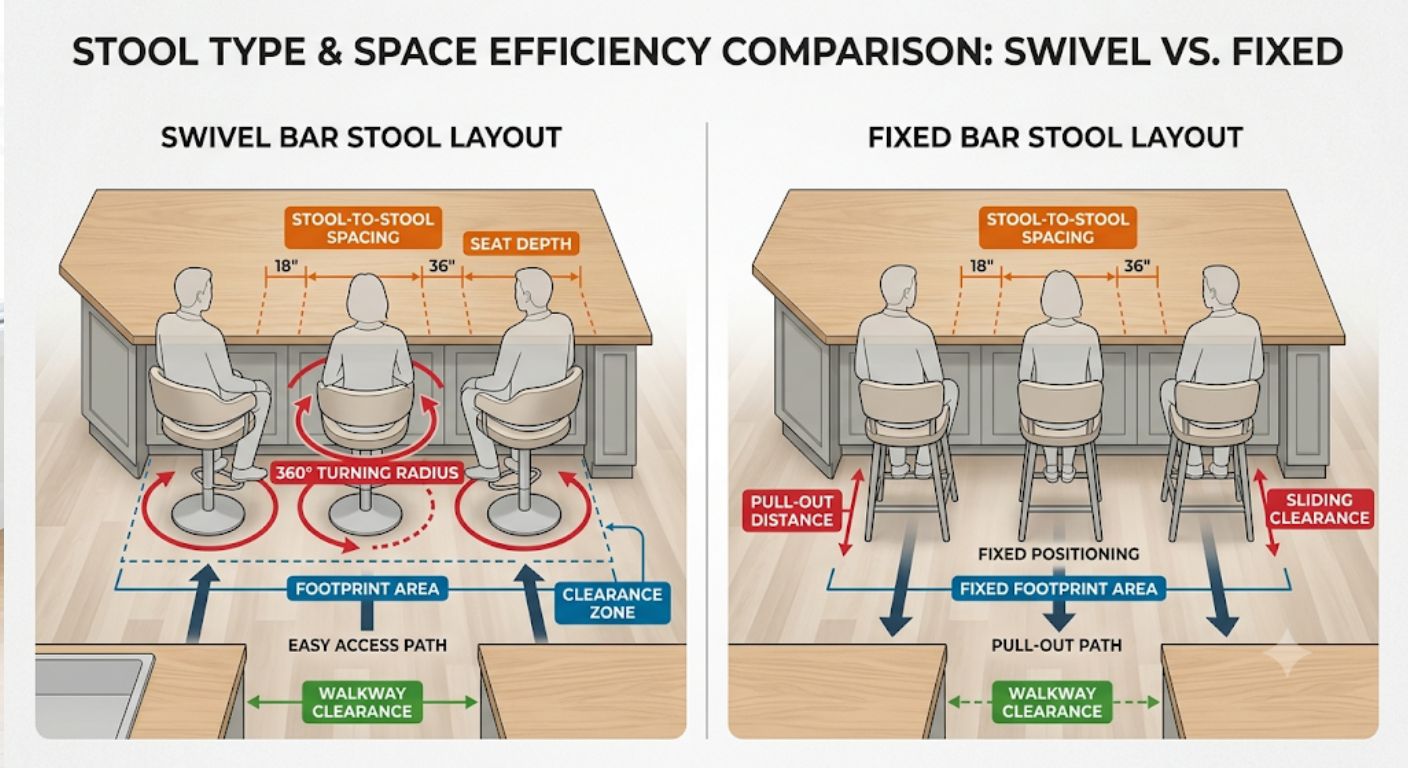
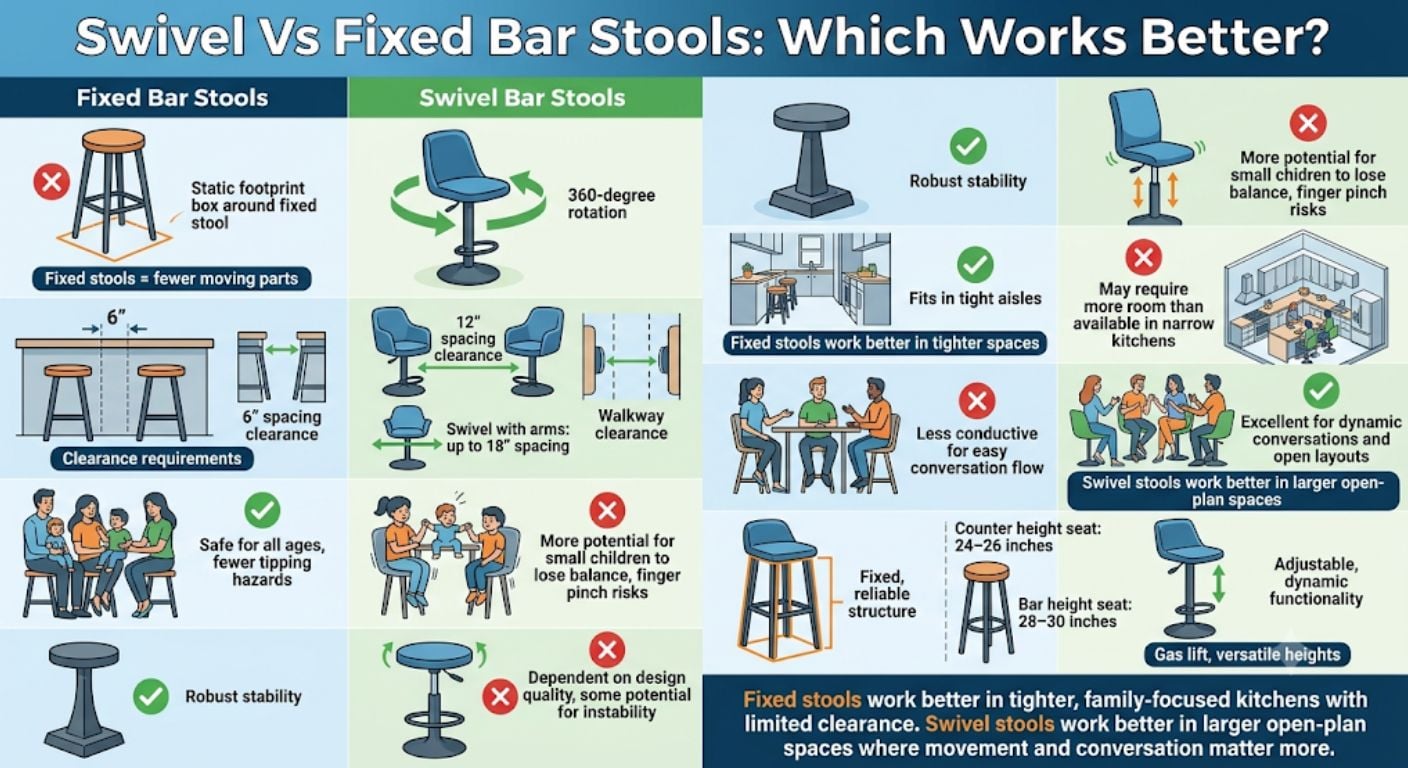
Fixed stools usually work better in narrow kitchens and tighter walkways because the usable footprint stays consistent. Swivel stools need additional turning space around the seat and elbows.
A practical spacing rule used across many kitchen layouts is:
- Fixed stools: allow roughly 6 inches clearance between seats
- Swivel stools: allow roughly 12 inches clearance
- Swivel stools with arms or wider backs: allow up to 18 inches
This matters most on compact islands where people walk behind seated users. A swivel seat can rotate into the walkway even when the base stays tucked under the counter.
We often find our customers focus heavily on seat width but underestimate how much extra working space swivel movement actually needs once people are sitting and turning naturally.
If you are planning seating around a narrow island, the guide on bar stools for small kitchens covers footprint and clearance in more detail.
Are Fixed Bar Stools More Stable Than Swivel Ones?
Yes. Fixed bar stools are generally more stable because there are fewer moving parts between the seat and base.
A swivel mechanism introduces an additional connection point. On well-made stools this should still feel secure, but over time cheaper swivel plates can develop movement, noise, or slight wobbling.
Fixed stools are usually the safer choice for:
- Homes with toddlers or younger children
- Very high-traffic kitchens
- Rental properties
- Users who prefer a rigid sitting position
- Narrow layouts with less floor space
Swivel stools are not unsafe by default, but children often treat them like spinning chairs. Finger pinching around exposed mechanisms can also become an issue on lower-quality stools.
For broader family-use considerations, the bar stools for rentals and Airbnbs guide explains which construction types hold up best under repeated daily use.
When Swivel Bar Stools Make More Sense
Swivel stools work especially well in open-plan kitchens and entertainment spaces where movement between zones happens constantly.
They are useful when:
- People regularly turn to talk across the room
- The kitchen island is used for entertaining
- Users do not want to drag stools across hard flooring
- Older users may benefit from easier access
- The layout has generous clearance around the island
Rotation reduces twisting through the lower back when getting on and off the seat. In wider kitchens, this makes the seating feel more flexible and relaxed.
Return-swivel mechanisms are particularly useful in open-plan kitchens because the seats automatically face forward again after use. This keeps the island looking tidier without manually repositioning every stool.
When Fixed Bar Stools Are Usually The Better Choice
Fixed stools suit practical kitchens where predictability and space efficiency matter more than movement.
They are usually a stronger choice when:
- The kitchen has narrow walkways
- The stools need to tuck neatly under the counter
- Children regularly use the seating
- You want minimal mechanical maintenance
- The seating is used mainly for short sitting periods
Fixed stools are also easier to position consistently around smaller islands. The footprint remains controlled because the seat always faces forward.
If keeping stools tucked under the worktop matters, Lakeland’s guide on seat depth and overhang clearance explains the measurements that affect protrusion.
Gas Lift Vs Fixed Height Bar Stools
Gas-lift stools allow the seat height to change using a hydraulic mechanism. Fixed-height stools stay at one seat height permanently.
This is separate from swivel functionality, although many gas-lift stools also swivel.
| Feature | Gas Lift | Fixed Height |
|---|---|---|
| Seat Height Flexibility | Adjustable | Single height only |
| Weight | Usually heavier | Usually lighter |
| Mechanical Complexity | Higher | Lower |
| Shared Household Use | Useful for mixed heights | Best when counter height is fixed and known |
| Price | Often higher | Usually lower |
For standard UK kitchen islands around 90cm high, most users need a seat height of roughly 65cm. For bar tables around 105cm high, seat heights around 75cm are more typical.
What Material Works Best For Busy Kitchens?
The material matters regardless of whether the stool swivels or stays fixed.
For homes with children or pets, the easiest options to maintain are usually:
- PU faux leather
- Sealed wood seats
- Powder-coated metal frames
- Compact low-texture upholstery
Fabric textures with deep pile or open weave tend to collect crumbs, pet hair, and spills more easily. Swivel stools can also place slightly more stress on upholstery seams because people twist while seated.
How To Decide Between Swivel And Fixed Bar Stools
The decision usually comes down to four factors:
- Kitchen size — smaller kitchens favour fixed stools
- Daily usage — social spaces favour swivel movement
- Who uses them — families with younger children often prefer fixed seating
- Clearance around the island — swivel stools need more operational space
If you are unsure, start with the physical layout first. Clearance limitations usually determine the right option faster than style preferences.
For most compact UK kitchens, fixed stools are the safer layout choice. For larger open-plan kitchens with wider circulation space, swivel stools often feel easier and more comfortable during longer use.
Conclusion
Swivel and fixed bar stools solve different problems. Swivel stools improve movement, conversation, and accessibility, while fixed stools offer greater stability and a more controlled footprint.
The right choice depends more on kitchen layout and daily usage than appearance alone. Clearance around the island, who uses the seating, and how long people typically sit there all matter more than whether the seat rotates.
If you are still comparing layouts, heights, and spacing rules, Lakeland’s bar stool size guide covers the wider measurement framework. You can also browse the full bar stool range to compare fixed, swivel, and adjustable designs side by side.


Comments